From activity tracking to pattern recognition
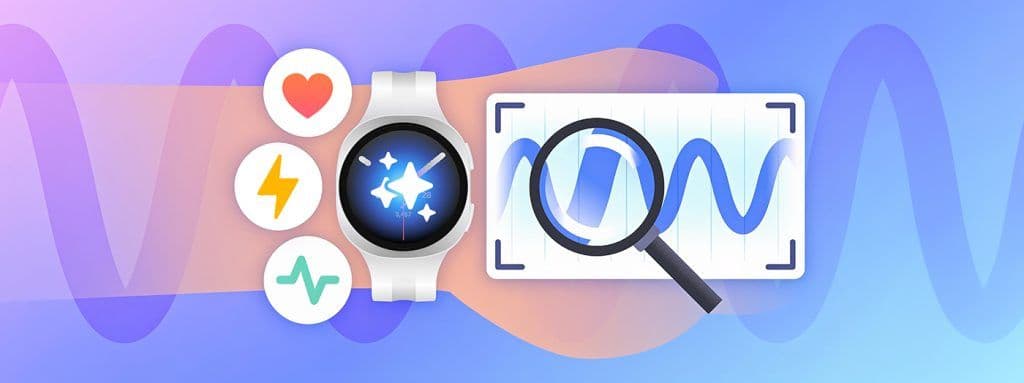
Smartwatches already collect heart rate, sleep and activity data, but useful interpretation is difficult because body signals change across seconds, hours and days. Samsung Research America has described two foundation models designed to learn those relationships from wearable data. The goal is not simply to add another score to a health dashboard, but to build models that can adapt to several health tasks after learning general patterns from largely unlabeled signals.
Connecting different measurements
The first model, xMAE, studies the relationship between electrocardiogram readings and photoplethysmography, the optical signal commonly collected continuously by watches. ECG can provide detailed cardiac information but usually requires an active measurement. PPG is easier to collect passively. Samsung says xMAE reconstructs masked ECG information from PPG and was pretrained on about 9,400 hours of paired data. It reportedly outperformed comparison methods in 15 of 19 evaluation tasks.
Reading the body at different speeds
HiMAE addresses time scale. A heartbeat changes quickly, while sleep and activity patterns emerge over longer periods. The model uses multiple encoders to examine short and long segments, then applies the learned representation to classification, prediction and data-generation tasks. Samsung reports that HiMAE can produce a result in under a millisecond on a smartwatch-class processor, suggesting some analysis could happen on the device rather than in the cloud.
The appeal and the caution
On-device processing could reduce latency and limit how much raw health data leaves a wearable. It could also make continuous insights possible without a permanent network connection. Yet research performance is not the same as a validated medical feature. Dataset diversity, sensor quality and clinical testing will determine whether these models work reliably across ages, skin tones, conditions and devices. False reassurance can be as harmful as a false alarm.
What to watch
Samsung’s work shows how wearable AI may shift from isolated measurements toward a longer, contextual view of health. The next milestones are independent validation, regulatory review for any medical claims, and clear explanations of what remains on-device. Until then, xMAE and HiMAE are promising research foundations, not replacements for professional diagnosis.
Consumers should also distinguish wellness guidance from medical diagnosis. A watch may become better at recognising patterns, but a model cannot account for every medication, condition or sensor error without appropriate evidence. Useful products will explain uncertainty, let people inspect the measurements behind an alert and provide a sensible route to professional care. Privacy controls should cover not only storage, but whether personal signals are used to improve future models.