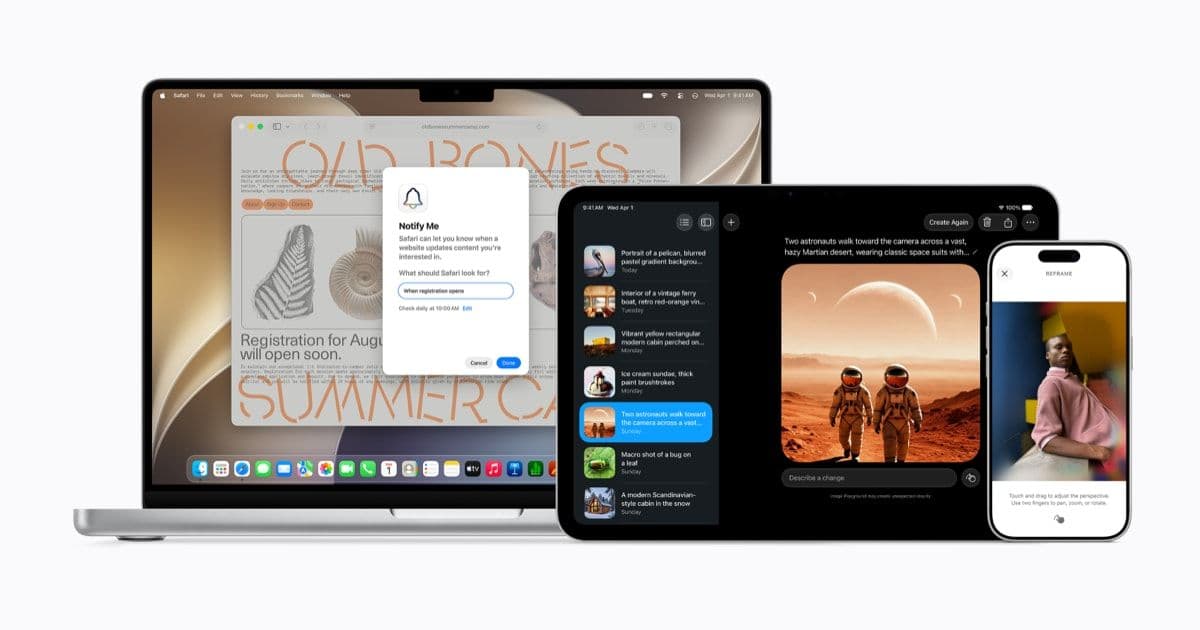
Apple’s next generation of Apple Intelligence changes more than the features people will see on their devices. It also changes where some of the underlying computation happens. In June 2026, Apple said that its Private Cloud Compute system would expand beyond infrastructure operated solely in Apple data centers. For selected workloads, the company is collaborating with Google and NVIDIA to run Apple Intelligence models on Google Cloud hardware while preserving the security architecture Apple designed for private inference.
That move is significant because personal AI systems are increasingly expected to reason over messages, photos, files, calendars and other sensitive context. The most useful assistants need access to information that people would not normally send to a conventional chatbot. Apple’s bet is that cloud AI can become more capable without requiring users to accept the usual model of trusting a provider’s administrators, logging systems and internal controls.
Why on-device AI is not enough
Running models locally remains the cleanest privacy boundary: the data stays on the device and the user controls the hardware. But phones and laptops have limited memory, power and thermal capacity. Complex reasoning, agentic tool use and larger multimodal models can exceed those limits. A system that insists on local processing for every task may protect privacy but deliver weaker results, longer delays or a narrower range of capabilities.
Apple’s architecture divides work according to what the task requires. Simpler requests can use an on-device foundation model. More demanding requests can move to Private Cloud Compute. The challenge is ensuring that this handoff does not quietly turn a private device experience into ordinary cloud processing. The value of the architecture therefore depends less on where the server sits and more on what the server is technically permitted to observe, retain and change.
The promise of verifiable cloud inference
Private Cloud Compute is designed around stateless processing. Apple says personal request data is used only to fulfil the request and is not retained afterward. Requests are encrypted to validated compute nodes, and the production software is made available for independent inspection. Devices are intended to send requests only to servers running software that matches a publicly inspectable record.
Extending that model to third-party data centers raises the bar. Apple no longer controls every physical facility or every underlying component. Its answer is to carry the trusted execution environment, attestation process and transparency mechanisms into Google Cloud systems using NVIDIA GPUs. If the design works as described, ownership of the building becomes less important than the cryptographic identity and observable software state of the node doing the work.
A partnership does not eliminate trust
Technical safeguards can reduce the number of parties a user must trust, but they do not make trust disappear. Researchers still need enough access and documentation to examine the system. Hardware supply chains, update mechanisms and operational procedures remain relevant. Users also need clear signals about which requests stay local, which enter the cloud and when outside models or services participate.
Apple’s collaboration with Google is particularly notable because it separates model development from the privacy boundary around inference. Google’s Gemini technology helped inform the new Apple Foundation Models, while Apple presents Private Cloud Compute as the system that governs how personal requests are processed. That separation could become a useful pattern: companies may combine models and infrastructure from several vendors while maintaining a distinct, independently testable privacy layer.
What developers need to account for
The 2026 Foundation Models updates also make Apple’s AI stack more flexible. Developers can work with improved on-device models, multimodal sessions and a protocol that can represent local or server-hosted language models. More flexibility creates more responsibility. Prompts should be tested across model versions, fallbacks should be explicit, and applications should collect no more personal context than a task genuinely needs.
Developers should also avoid treating a privacy-preserving inference service as permission to send everything. Data minimisation still matters. A well-designed application should define the smallest useful context, communicate when a remote model is involved and remain functional when cloud processing is unavailable or declined. Privacy architecture is strongest when product decisions reinforce it rather than merely relying on it.
A broader test for personal AI
The larger question is whether verifiable confidential computing can become a practical foundation for personal AI across the industry. Consumers increasingly want assistants that understand their lives, but they are also being asked to share unprecedented amounts of private information. Conventional privacy policies are a weak answer because they depend on promises that are difficult for outsiders to test.
Apple’s expansion of Private Cloud Compute is therefore worth watching beyond the Apple ecosystem. It attempts to turn privacy from a contractual assurance into a property enforced by hardware, cryptography and inspectable software. The approach will still require scrutiny, and real-world implementation matters more than architectural claims. But it points toward a useful standard: powerful personal AI should not require invisible access to the person it is supposed to serve.
What to watch next
For developers and buyers, the practical questions are now easier to state. Which requests stay on the device, which move to confidential cloud infrastructure, and what happens when neither route is available? Apple will also need to show that outside infrastructure cannot quietly weaken its guarantees as providers, chips and model workloads change. Independent researchers need enough access to test the claims, while ordinary users need explanations that do not require security expertise. The strongest outcome would be competition around verifiable privacy rather than vague assurances. If rival platforms adopt comparable inspection, attestation and data-retention limits, cloud AI could become more capable without normalising unlimited collection. That would make this expansion more than an Apple scaling story: it would turn an unusual security architecture into a benchmark the wider personal-computing market can challenge and improve.