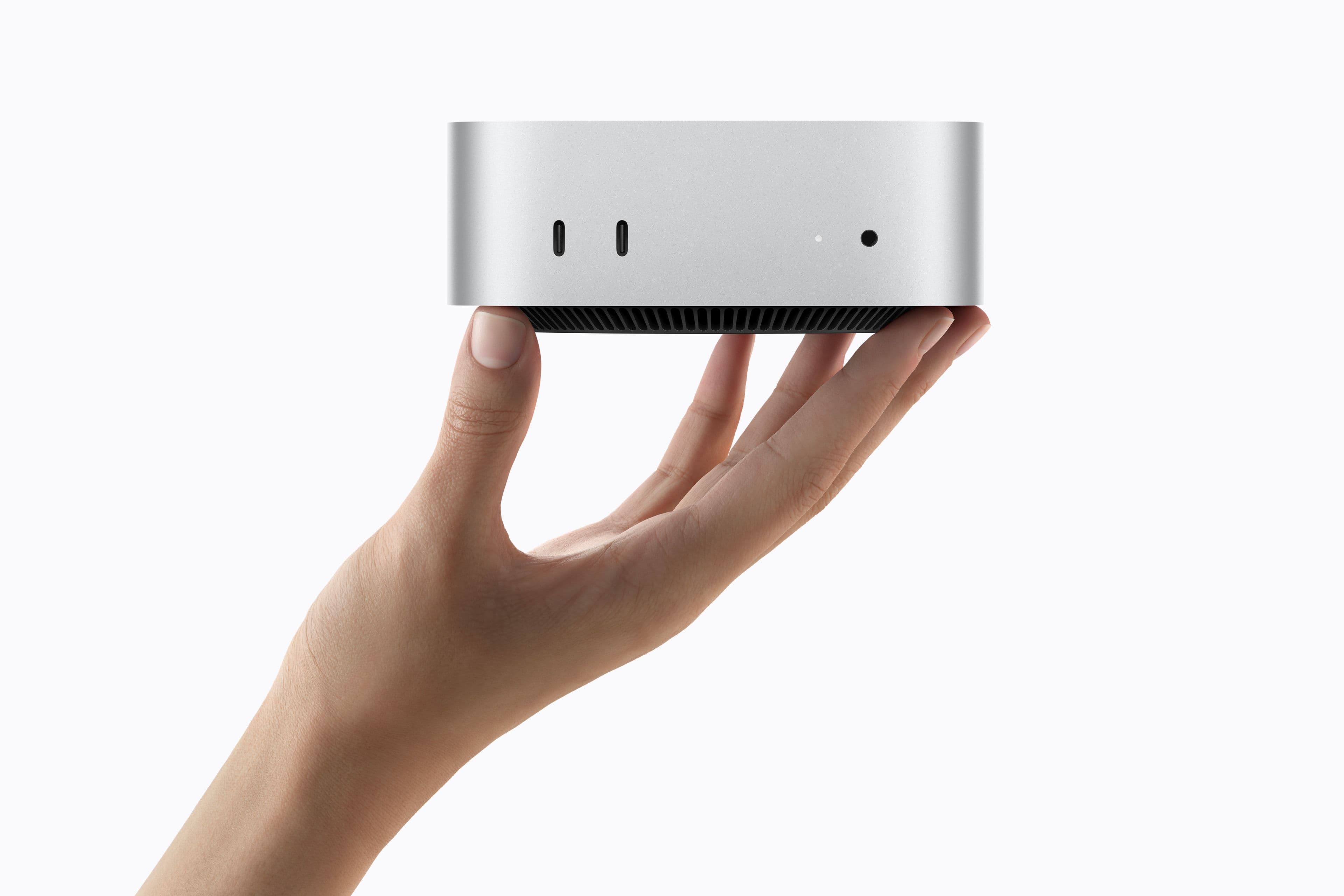
Apple’s latest desktop announcement looks, at first, like a familiar performance refresh. The Mac mini now comes with either the new M6 or M5 Pro, while Mac Studio moves to M5 Max and M5 Ultra. The enclosures remain compact and recognisable. Inside them, however, Apple is making a more consequential argument: the desktop Mac is becoming a machine for running advanced AI locally, continuously and with fewer compromises.
That framing connects machines built for very different buyers. The Mac mini remains the approachable, flexible desktop that can sit in a home office, development setup or business deployment. Mac Studio is designed for professionals whose work can use exceptional graphics, memory and media performance. Across both, Apple is emphasising Neural Accelerators in the GPU, faster unified memory, on-device models and the ability to keep demanding workloads close to the user’s data.
Mac mini begins a new chip generation
The M6 Mac mini is the first of the new machines to move beyond the M5 family. Apple says M6 uses a 12-core CPU and 12-core GPU, with Neural Accelerators in every GPU core. Compared with the M4 Mac mini, Apple claims up to four times faster AI performance, twice the graphics performance and 40 percent faster CPU performance. Standard unified memory remains 16GB and can be configured up to 32GB, with bandwidth reaching 170GB per second.
Those gains matter beyond benchmark charts because Mac mini is often left running as infrastructure. It can host development tools, automation, media libraries or local services without taking over a desk. Apple now explicitly describes it as an always-on machine for agentic workflows. Whether that becomes a common use will depend on software, but it gives the smallest Mac a clearer role than simply being the inexpensive way into macOS.
M5 Pro gives the mini room for serious work
The M5 Pro version stretches the same footprint toward professional workflows. It offers up to an 18-core CPU, a 20-core GPU, 64GB of unified memory and 307GB per second of memory bandwidth. Thunderbolt 5 also makes it better suited to fast storage, high-resolution displays and clustered systems. Apple highlights development, video production, scientific simulation and local generative models as representative workloads.
Choosing between M6 and M5 Pro is therefore not a simple generation comparison. M6 brings newer architecture and large gains for mainstream and AI-assisted work, while M5 Pro provides more memory, GPU scale and connectivity for sustained professional tasks. Buyers should decide from the workload and memory requirement rather than assuming that the newest number is automatically the fastest option in every situation.
Mac Studio turns unified memory into an AI advantage
Mac Studio makes Apple’s local-AI case more dramatic. With M5 Max it reaches an 18-core CPU, up to a 40-core GPU and as much as 128GB of unified memory. M5 Ultra doubles the scale to a 36-core CPU, up to an 80-core GPU and a remarkable 512GB of unified memory, backed by 1.2TB per second of bandwidth. Apple says the Ultra configuration can run enormous language models entirely on the device.
Unified memory is important here because the CPU, GPU and specialised engines can work with one large pool rather than repeatedly copying data between separate system and graphics memory. For video, 3D and scientific work that has long been useful. For AI, it can determine whether a model fits on the machine at all. A high-end Studio is expensive, but it offers researchers and studios a private local system without per-token cloud charges or constant transfer of sensitive material.
Clustering changes what a compact desktop can be
Apple is also leaning into multiple-machine setups. Thunderbolt 5 and remote direct memory access allow Mac Studio systems to be clustered for distributed inference; Apple says four systems can deliver up to three times the inference performance of one. Mac mini with M5 Pro can also participate in clustered workflows. This does not turn a few desktop Macs into a universal replacement for data-centre accelerators, but it creates an accessible path for teams that need substantial local compute without conventional server hardware.
The appeal is as much operational as technical. A creative studio, laboratory or software team can begin with one machine and expand when workloads justify it. Quiet, compact systems can live near the people using them, while data can remain within the organisation. The trade-offs will include cost, software maturity, power use and whether distributed tools support the required models reliably.
Connectivity catches up with the workload
Both families add Wi-Fi 7, Bluetooth 6 and faster wired networking. Mac mini now includes 2.5Gb Ethernet as standard with a 10Gb option, while its M5 Pro configuration provides Thunderbolt 5. Mac Studio combines Thunderbolt 5 with its broader set of professional ports and can support up to eight displays. These details are less visible than a new chip, but they matter when models, media and project files reach hundreds of gigabytes.
The computers also arrive alongside macOS 27 and Apple’s next generation of Apple Intelligence. Apple is introducing Core AI as a framework for building, running and deploying models on Apple silicon, while continuing to support MLX for local development and fine-tuning. Hardware alone cannot create an AI workstation ecosystem; frameworks, model compatibility and dependable professional applications will decide whether the new capacity is genuinely useful.
The desktop Mac now has a sharper purpose
Apple’s August announcement does not radically redesign either computer. Instead, it clarifies why desktops still matter in a world dominated by laptops and cloud services. A desktop can dedicate its thermal capacity, memory and connectivity to demanding work, remain available all day and keep large models beside the data they process. Mac mini makes that proposition relatively approachable. Mac Studio pushes it to a scale intended for specialists.
For most people, the M6 Mac mini will be more computer than everyday work requires, and a Mac Studio with M5 Ultra is deliberately specialised. The interesting development is the range between them. Apple now offers a small desktop ladder from ordinary productivity to frontier-class local models while keeping a consistent software platform and compact form. That makes this release less about replacing last year’s Mac and more about preparing the Mac desktop for a different balance between cloud intelligence and computing that happens in the room.